
Solitaire has remained a favorite for generations, and learning solitaire game rules opens the door to hours of engaging, single-player fun. Whether you’re diving into the classic version or trying a new twist like Spider or TriPeaks, understanding the rules and setup is key to enjoying this timeless card game.
What Is Solitaire? A Brief Introduction
Solitaire, also known in some regions as patience, is a solo card game where the goal is to organize cards into a specific order. Over the years, many versions have emerged, but the core gameplay typically involves sorting cards by suit and rank through strategic moves.
Classic Solitaire Game Rules (Klondike)
The most popular version is Klondike Solitaire, often referred to simply as “classic solitaire.” Here’s how to play:
Card Set Up for Solitaire
- Use a standard 52-card deck.
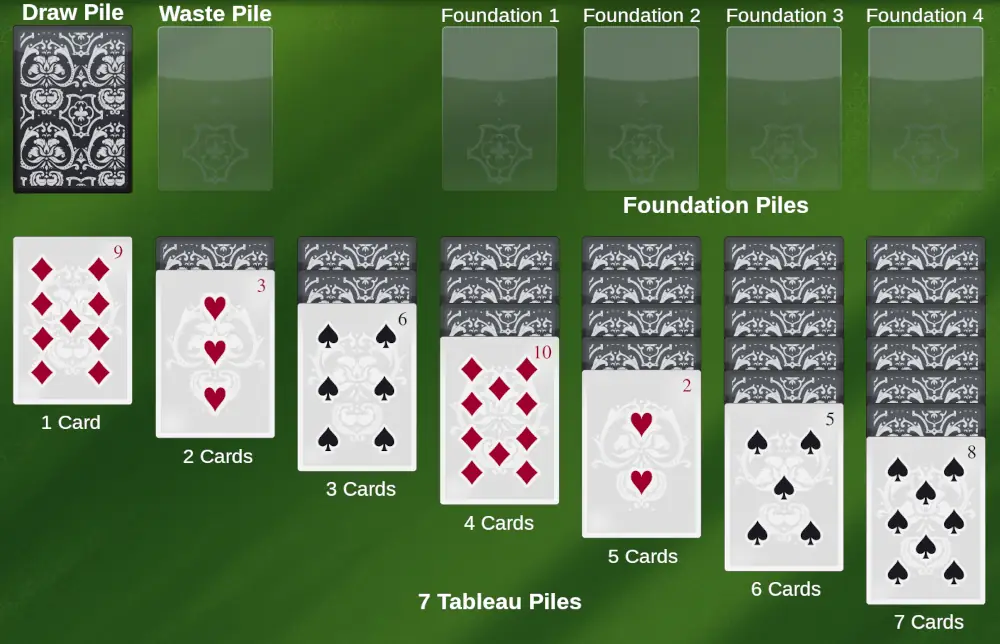
- Deal seven tableau piles: 1 card in the first pile, 2 in the second, and so on.
- The top card of each pile is face-up.
- Set aside space for the draw pile, waste pile, foundation piles (4), and tableau.
Objective
Move all cards to the foundation piles by suit, from Ace to King.
Solitaire Game Rules: Game Play
- You can move face-up cards within the tableau in descending order and alternating colors.
- Only Kings can fill empty tableau spaces.
- Draw cards from the stock pile to play to the tableau or foundations.
- Only Aces can be placed on empty foundations
Solitaire Game Rules: Winning
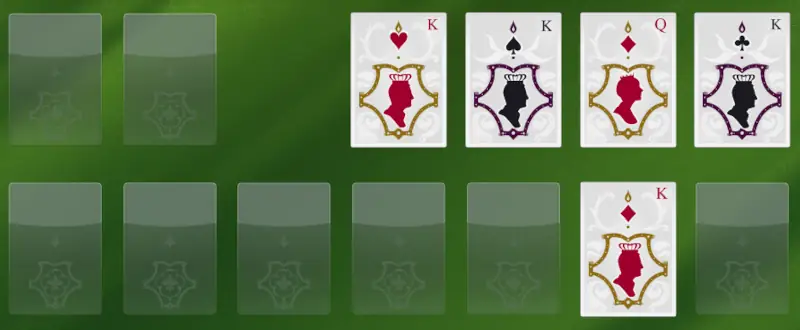
You win by completing all four foundation piles. Each pile consists of the cards from each suite in order from Ace to King. The following image shows the final card to place in order to win a game of solitaire. To win this game, the King of diamonds must be placed on the Queen of diamonds to complete this final suite in order from Ace to King.
Classic Solitaire Game Example
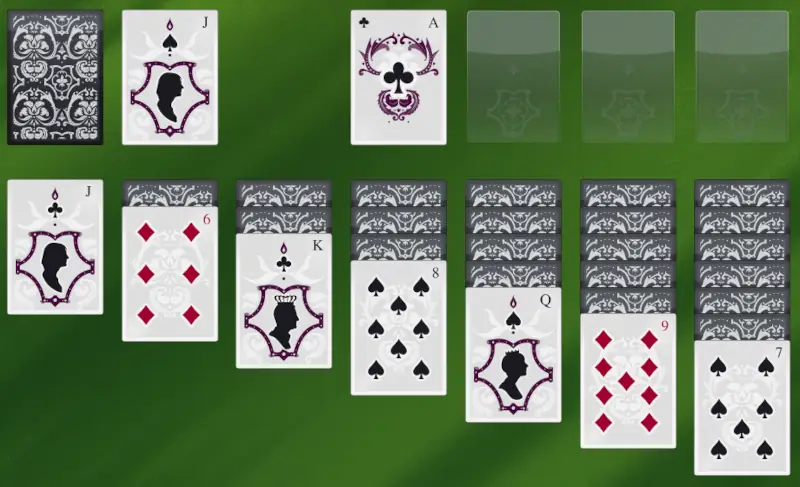
An example of a classic solitaire game follows. In the image below, the deck was shuffled, and the seven tableau stacks dealt. After this, some cards were flipped from the draw pile onto the waste pile. Finally, an Ace card was found in the draw pile and placed in one of the foundation piles.
Solitaire Game Rules: Stacking Tableau Piles
For the next move, one possibility in the above image is to put the black 8 of spades onto the red 9 of diamonds instead of flipping the next card from the draw pile. This obeys the solitaire game rules by placing alternating card colors in descending order in the tableau piles. As a result, the card that is under the 8 of spades can be flipped over.
The following image shows the move described above. In this case, the card that was under the 8 of spades is flipped over and is the 6 of clubs. The six of clubs can’t be moved anywhere at the moment, because it can only be placed on a red 7 card which is not currently facing up. Alternately, if one of the foundation piles was made up of the Ace of clubs, through to the 5 of clubs, then the 6 of clubs card could be placed on that foundation pile. It is too early in the game for that move at this stage.
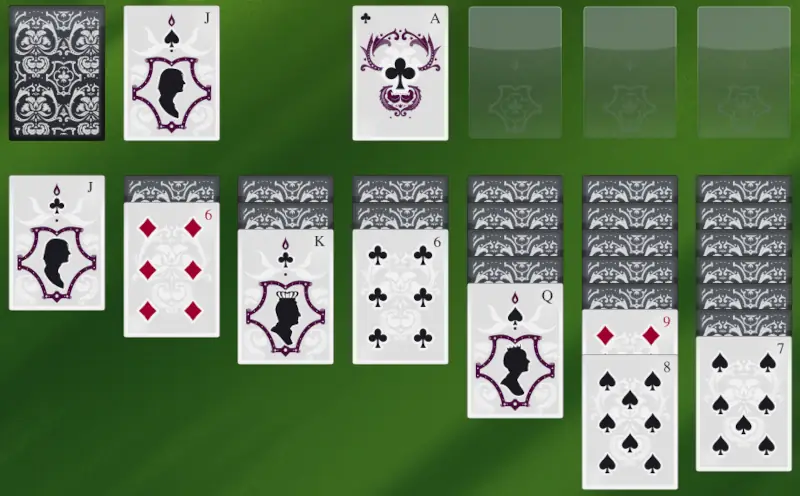
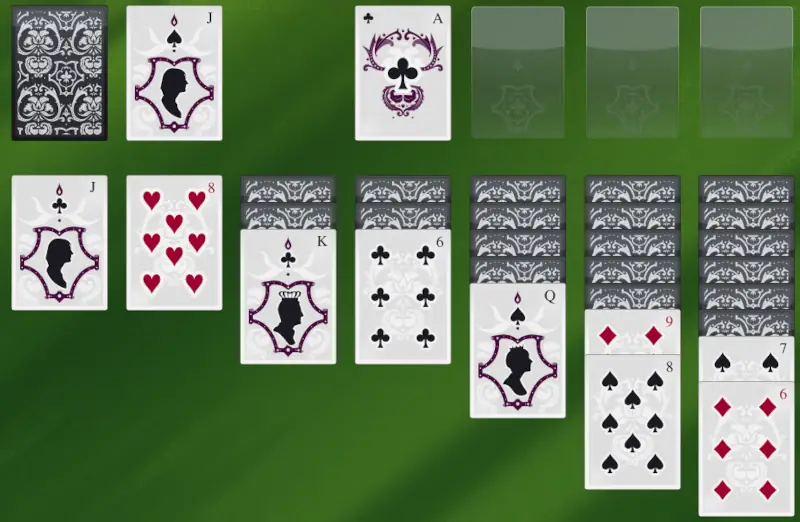
In the above image, the 6 of diamonds in the second tableau pile can be moved onto the 7 of spades in the last, or 7th tableau pile. The following image shows that move. After removing the 6 of diamonds from the second tableau pile, the card under it is flipped and revealed to be the 8 of hearts.
Stacking Tableau Piles: Moving More than One Card
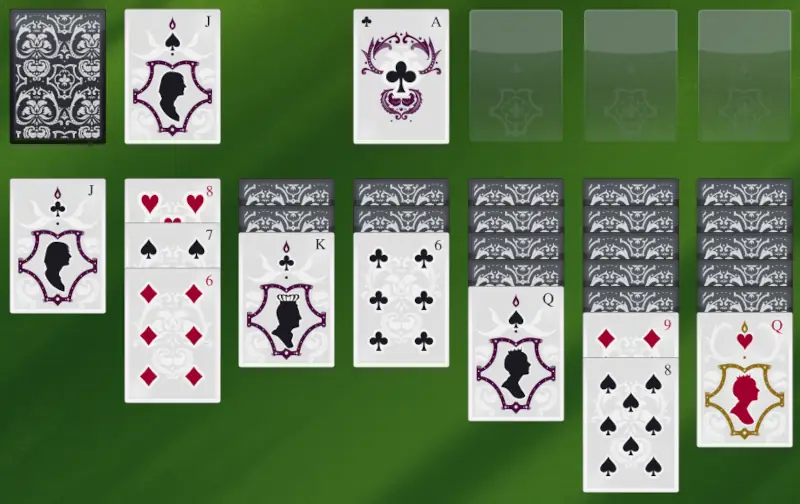
A final example of solitaire game rules for stacking tableau piles is that a whole stack of tableau cards that are facing up can be moved to a valid tableau pile. In the above image, the last of pile of facing cards on the right can be moved to the second pile on the left. That is, the 7 of spades can be placed on the 8 of hearts. Because the 7 of spades has the 6 of diamonds on top of it, both cards are moved. The result is shown in the following image.
The first card that was under the 7 of spades is flipped over after removing the 7 of spades and the 6 of diamonds that was on top of it. The flipped card is revealed to be the Queen of hearts.
Solitaire Game Rules: Stacking Foundation Piles
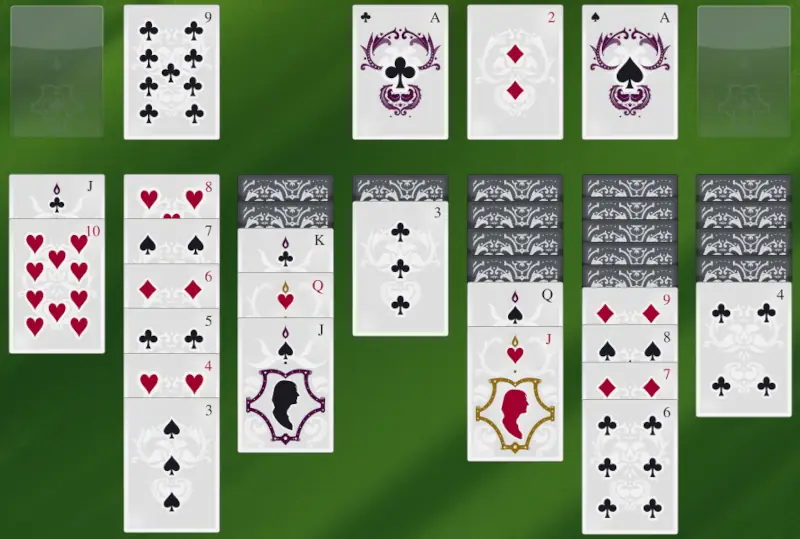
After this example game has progressed for a while, two more Ace cards are found and placed in the foundation card positions (the Ace of diamonds, and the Ace of spades). After this, a 2 of diamonds is found and placed on the Ace of diamonds in the foundation pile.
The following image shows the moves that are described above.
Empty Tableau Pile and Flipping the Waste Pile
In the above image, the last draw pile card that was flipped onto the waste pile is the 9 of clubs. This can be placed on the 10 of hearts in the first tableau pile. After this, the entire second tableau pile can be placed on the 9 of clubs card. This follows the solitaire game rules, as all cards in this final pile are alternating colors and descending order. The following image shows the result.
The second tableau pile is now empty. Only a King can be placed in this spot according to the solitaire game rules.
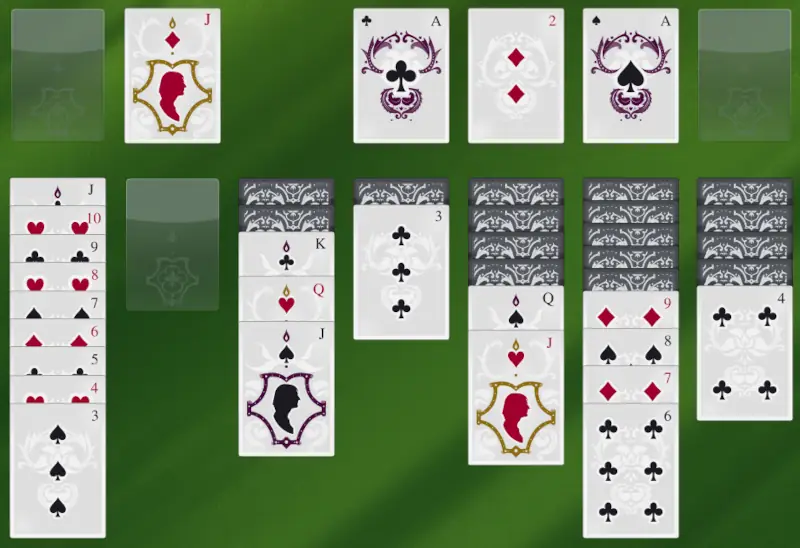
The King of clubs in the third tableau pile of facing cards can be moved to the empty tableau space, with all of the facing cards that are on top of it. This is shown in the following image. The card that was under the King of spades is now flipped over. It turned out to be the Ace of hearts which is then placed in the final empty foundation card slot. The card that was under the Ace of hearts is flipped and revealed to be the 3 of hearts.
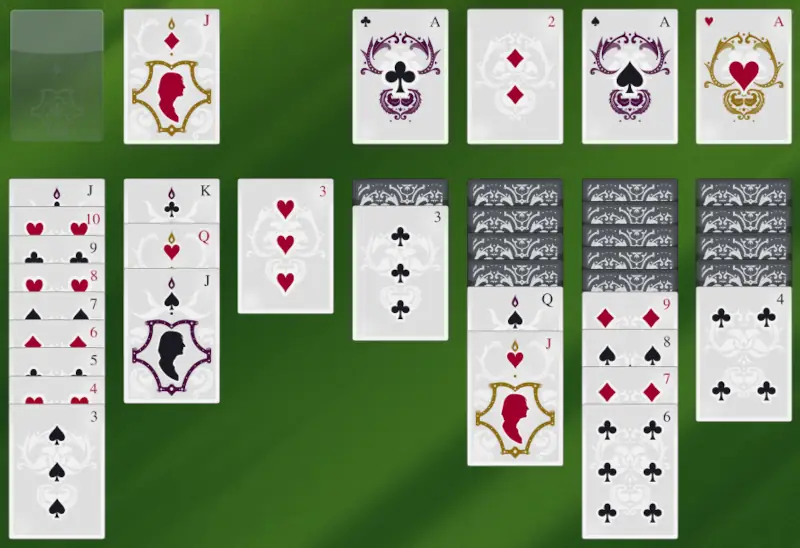
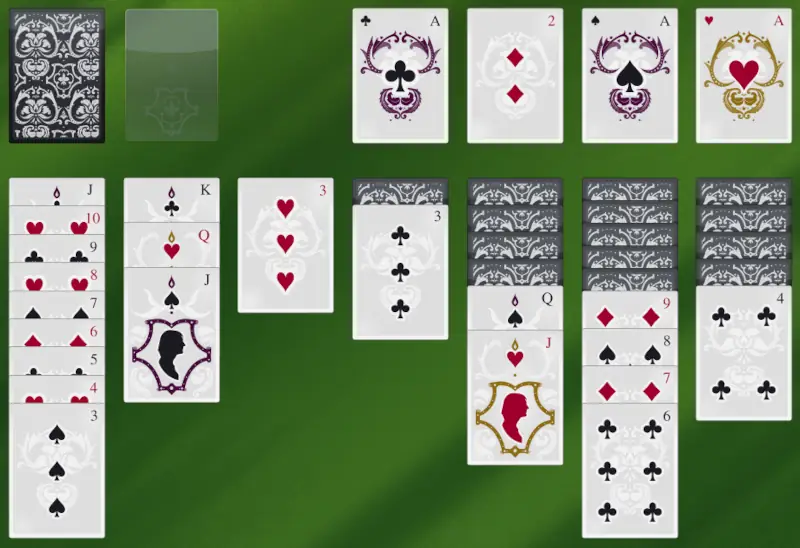
At this stage in the game, all the draw pile cards were flipped onto the waste pile. The waste pile now consists of all the draw pile cards, except the ones that were put on the foundation piles, or on the tableau piles. This means that the entire waste pile is now flipped over and becomes the draw pile again.
The following image shows that the waste pile is flipped over to become the draw pile again, as already described.
End of the Solitaire Game
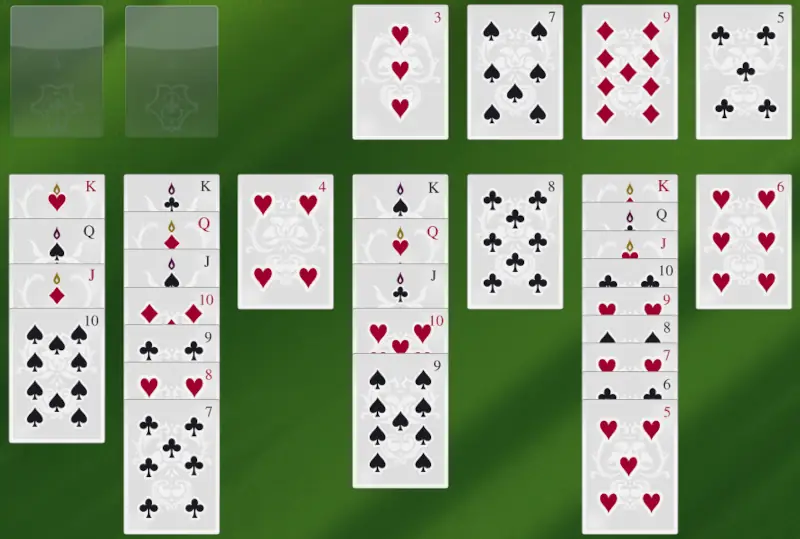
At this stage the game is coming to an end, as can be seen in the following image. Most of the cards have been flipped.
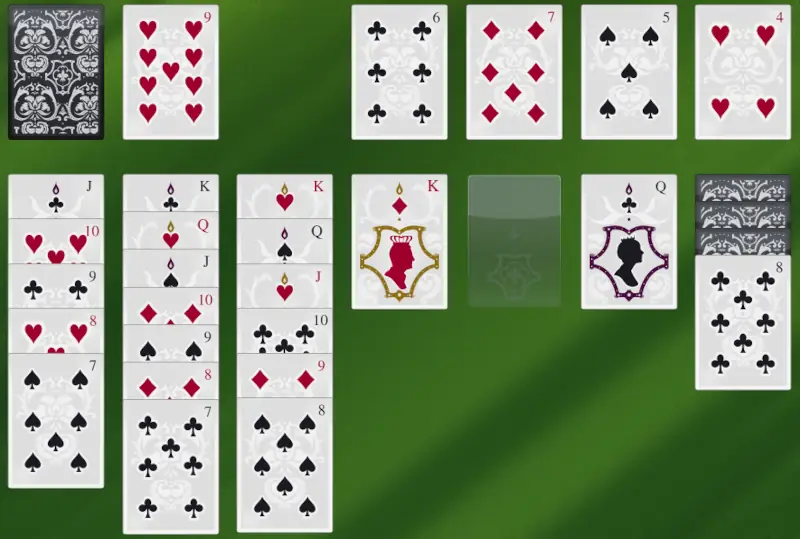
Once all the cards are flipped, it is only a matter of moving the cards from the tableau piles to the correct positions in the foundation piles in the correct order.
In the following image this can easily be done, for example the 4 of hearts is placed on the three of hearts. The 5 of hearts can then be placed on the 4 of hearts that is on the foundation pile. This frees up the 6 of clubs that is placed on the 5 of clubs on the foundation pile, and so forth.
Spider Solitaire Game Rules
Spider solitaire rules use two decks (104 cards) and are more complex:
- Build sequences from King to Ace in the same suit.
- Completed runs are removed from play.
- You can move groups of cards if they are in correct descending order.
- New cards are dealt in rows when you run out of moves.
Spider solitaire is perfect for players seeking a greater challenge.
Klondike Solitaire Game Rules
As mentioned, Klondike solitaire rules are the most commonly played and are ideal for beginners. To reiterate:
- The tableau contains 7 piles with increasing cards.
- Cards must be alternated by color in descending order.
- Aces go to the foundation piles first, then build upward by suit.
Pyramid Solitaire Game Rules
Pyramid solitaire involves a different layout and objective:
- 28 cards are dealt in a pyramid shape (7 rows).
- Only uncovered cards are playable.
- Match pairs that add up to 13 (e.g., Queen + Ace, 10 + 3) to remove them.
- Kings are removed on their own.
- The game ends when no more valid pairs are available.
TriPeaks Solitaire Rules
TriPeaks solitaire has three pyramid-shaped peaks.
- Cards are dealt into overlapping piles forming the peaks.
- You play from a draw pile to build upward or downward sequences (e.g., 4 → 3 or 4 → 5).
- Suit doesn’t matter.
- Clear all cards from the peaks to win.
Clock Solitaire Rules
Clock solitaire rules offer a purely luck-based game.
- Arrange 12 piles in a clock formation, plus one in the center.
- Each pile represents a number (Ace = 1, Jack = 11, etc.).
- Draw from the center and place cards under their matching position.
- You lose if the 4th King appears before completing the clock.
Card Game Patience Rules
“Card game patience rules” is simply another term for solitaire rules, particularly in the UK and Europe. These rules typically align with classic solitaire card game rules like Klondike, though the terminology may vary.
Directions for Playing Solitaire (General Tips)
- Start with the longest face-down tableau pile to uncover more cards early.
- Build evenly across tableau piles to avoid blocked moves.
- Use undo cautiously (in digital versions) and focus on building the foundation steadily.
FAQ: Solitaire Game Rules
What Are the Basic Solitaire Rules?
The basic solitaire rules involve organizing cards into suit-based piles from Ace to King. You use strategic moves within a tableau, drawing from a stock pile when needed.
How Do You Set Up Cards for Solitaire?
The card set up for solitaire involves seven tableau piles, with an increasing number of cards from left to right. Only the top card of each pile is face-up, and the rest form the stock pile.
What’s the Difference Between Solitaire and Patience?
There’s no difference in gameplay. Card game patience rules are the same as solitaire, “patience” is the British term for solitaire.
Can You Move Multiple Cards in Solitaire?
In most solitaire games, including Klondike solitaire rules, you can only move multiple cards if they are in descending order and alternating colors. Spider allows larger grouped moves based on suit.
Which Solitaire Game Is Easiest to Learn?
Classic solitaire (Klondike) is the easiest to learn and play, followed by TriPeaks, which has simpler matching mechanics.
Final Thoughts on Solitaire Game Rules
From classic solitaire rules to spider, clock, and pyramid, solitaire offers countless ways to enjoy solo gameplay. By learning the unique setup and strategies for each variation, you can explore endless ways to challenge yourself, relax, and have fun.
For even more card game tutorials and rule breakdowns, explore the full Card Games category here on GameRulesHub.com.